
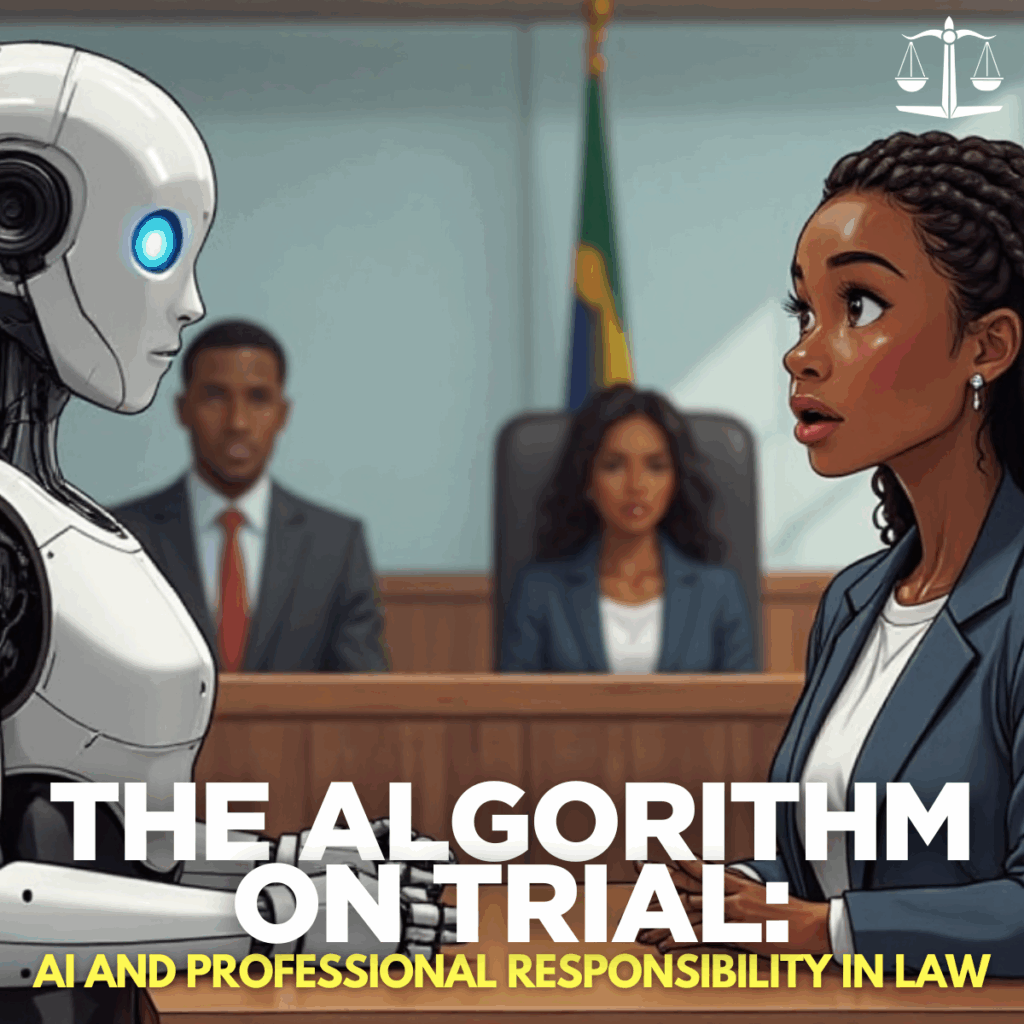
“The Algorithm on Trial: Artificial Intelligence and Professional Responsibility in Law”
A day in the life of a law student at the University of the Witwatersrand before 2010 often began with a pilgrimage to the law library, a towering sanctuary of over a million law reports and books covering every corner of the legal universe. As a first-year student, you wandered from floor to floor, corner to corner, sheepishly asking the librarian for guidance, clutching books like precious treasures, and timing your checkouts so that you could return them immediately after submitting your assignment. There was a certain ritualistic thrill in navigating this labyrinth of legal knowledge: the intoxicating smell of old pages, the hushed hum of diligent students, and the sheer satisfaction of finally laying your hands on the exact book you’d been chasing. Relief, excitement, anxiety, and pride collided in equal measure as you settled into a quiet corner, immersing yourself in the wisdom of those who came before.
And then there were those moments at a crowded table, eyeing a book your colleague had pulled out and thinking, that’s exactly what I need for this assessment but how do I ask? Especially if you were an introverted, “I-can-do-it-all-myself” type, the prospect of interrupting felt monumental. You finally mustered a smile, mustered a few words, and asked. The colleague nodded, the tension melted, and a small victory was yours. Add to that the nerve-wracking excitement of a one-on-one consultation with a law professor you secretly hoped to impress, and suddenly the library wasn’t just a repository of knowledge, it was a stage for tiny triumphs, quiet anxieties, and moments of pride.
And though the computer laboratory on the ground floor was easily accessible, many students still opted for the tactile adventure of hunting through the stacks. Then came AI, where a case or commentary that once took hours to track down could now be found in less than a minute. Let’s dive in and explore how this new world order might look, and what it means for the law, the legal profession, and the very rules that guide us.
The most widely publicised precedent is the decision in Mata v Avianca Inc (United States District Court, Southern District of New York, 2023). In that matter, counsel submitted written argument relying on AI-generated case law. Several authorities cited in the brief were later found to be entirely fictitious, fabricated by the AI system. The presiding judge, Castel J, described the conduct as a “cautionary tale,” noting that while technological assistance may be permissible, professional responsibility could not be abdicated. The attorneys were sanctioned for their failure to independently verify sources.
This case has been cited internationally as the first judicial pronouncement on the misuse of generative AI in legal practice. It illustrates two enduring principles: first, that AI outputs may be persuasive in style while wholly inaccurate in substance; second, that courts will not tolerate practitioners abdicating their duty of diligence to software.
In many ways, this mirrors the traditional lessons learned in the stacks of the law library: knowledge is only as valuable as the effort invested in seeking, verifying, and applying it. AI may accelerate the hunt, but it cannot replace the careful, deliberate engagement with the law that defines professional integrity. As legal practice increasingly integrates AI tools, understanding these boundaries becomes essential not just to avoid sanctions but to uphold the trust and authority that the profession demands.
South Africa has not been immune to similar experiences. In 2024, reports emerged of Senior Counsel citing AI-generated “authorities” which, upon review, were found to be non-existent. These matters were referred to professional bodies for disciplinary investigation. Although the details remain confidential, their very occurrence demonstrates that even highly experienced practitioners can fall victim to the plausibility of AI-generated outputs.
Beyond litigation, arbitral bodies are also beginning to confront the implications of AI. The Association of Arbitrators (Southern Africa) (AASA) in 2024 issued Guidelines on the Use of Artificial Intelligence in Alternative Dispute Resolution Proceedings. These guidelines are not legally binding but provide a valuable framework. They emphasise the importance of accountability (arbitrators may not delegate their adjudicative role to software), confidentiality (the need to protect sensitive data from exposure in public AI models), transparency (the desirability of disclosure of AI use), and fairness (ensuring no party is prejudiced by unequal access to technology).
Globally, regulatory approaches are emerging. The European Union’s AI Act, expected to come into force in 2025, classifies applications of AI in legal adjudication as “high risk,” requiring strict compliance with standards of transparency, oversight, and reliability. Other jurisdictions, including Canada and Singapore, have launched consultations on AI in legal services, with a focus on balancing innovation with professional responsibility.
Confidentiality is a cornerstone of practice. This principle is jeopardised if practitioners upload privileged or sensitive material into publicly accessible AI systems. Such conduct may amount to a breach of client confidentiality and contravene the Protection of Personal Information Act 4 of 2013 (POPIA). Unlike traditional legal databases such as LexisNexis or Jutastat, public AI platforms generally do not guarantee data isolation or privilege. Notably, the LexisNexis AI version affords explicit guarantees for confidentiality, safety, and compliance with privacy laws, potentially offering a viable solution for practitioners seeking to leverage AI while upholding their professional obligations.
It also delivers verified law reports and authoritative information while clearly indicating when content has not been verified. This dual function, combining robust data protection with reliable, transparent information, suggests that LexisNexis AI may offer a viable solution for practitioners seeking to integrate AI tools responsibly. From an analytical perspective, the platform mitigates the ethical and legal risks associated with AI-assisted research while maintaining professional standards, highlighting the importance of using specialised, trusted systems over public AI for legal work.
Section 34 of the Constitution of the Republic of South Africa, 1996 guarantees the right to a fair hearing. If one party in arbitration or litigation has access to sophisticated AI tools and the other does not, questions of fairness inevitably arise. This is particularly concerning in disputes involving self-represented litigants, smaller firms, or clients with fewer resources. AI could entrench existing inequalities if its adoption is unevenly distributed.
The phenomenon of “hallucinations,” where AI produces plausible but fabricated answers, presents obvious dangers. In legal and other high-stakes contexts, reliance on unverified AI-generated text may mislead tribunals, distort evidence, and undermine the integrity of justice. Beyond hallucinations, AI systems are susceptible to glitches such as contradictory outputs, partial answers, or failure to retrieve relevant information, each of which may compromise reliability. These systems also display a tendency to offer complimentary or overly agreeable responses, which can create a false impression of authority and encourage users to accept results uncritically. Equally concerning is the presence of embedded biases within training data, which can replicate discriminatory patterns or privilege certain viewpoints, potentially skewing outcomes in ways that remain invisible to users. For these reasons, human oversight is indispensable: AI-generated content should be scrutinised, cross-checked against authoritative sources, and supplemented by expert interpretation to ensure both accuracy and fairness.
The traditional billable hour model is premised on time. If AI tools enable tasks to be completed in minutes rather than days, legal practitioners might be faced with pressure to justify their fees. Fixed-fee or value-based billing, which charges for expertise and outcome rather than duration, may become more prevalent. However, the use of secure, privacy-compliant AI tools may require investment in encrypted infrastructure or enterprise-grade solutions, which carry higher fees than public or consumer-facing models. Internet access costs, ongoing training for staff to use these tools effectively, and compliance with data protection regulations also represent real expenditures. Consequently, any transition from hourly billing to value-based models should consider not only time savings but also the technology, infrastructure, and compliance costs inherent in AI-assisted legal work.
Courts and legal practitioners are increasingly adopting digital systems such as CaseLines, Court Online, and LexisNexis with AI, the latter of which now features AI-driven tools that are gaining significant traction in the profession. These tools assist with legal research, case analysis, drafting, and predictive analytics, streamlining workflow and reducing administrative burdens. Yet, the question emerges: what does this mean for professional standards, ethics, and education?
Reflective pause: When I log onto these platforms, am I enhancing my understanding of the law, or am I outsourcing too much of my reasoning to technology?
There should be no shame in leveraging technology responsibly – AI can enhance research efficiency, highlight relevant case law, and even identify overlooked precedents. However, reliance on AI must never substitute the legal practitioner’s own professional judgment, critical thinking, and legal reasoning.
AI should be an aid, not an arbiter. The benchmark remains: Would a reasonable legal practitioner reach the same conclusion independently of AI? If the answer is no, the legal profession risks eroding the standards of diligence, reasoning, and judgment that underpin legal practice.
The integration of AI into legal education raises fundamental questions: Are we producing legal practitioners who can critically supervise AI, or merely operators of algorithms? How can curricula balance technological proficiency with the preservation of ethical judgment and independent legal reasoning? These questions are central to ensuring that South African legal education continues to produce competent, ethical, and resilient professionals.
Plagiarism has long been the law student’s bogeyman; the spectre of copying without attribution, whether from a fellow student, a case report, or a textbook. In the library, students carefully cited every source, returned books on time, and double-checked quotes, all to ensure their work was unquestionably their own. But now, in the age of AI, the landscape is shifting in subtle and sometimes confusing ways.
AI can generate text, summarise cases, or even draft legal arguments, which raises the question: if the words come from an algorithm, is it plagiarism? The answer is yes, if you present AI-generated content as your own without disclosure or verification. Just as a student wouldn’t copy a colleague’s notes, a lawyer or student cannot rely blindly on AI output. The key principle remains unchanged: work must be attributable, accurate, and verifiable.
AI may change how we access and synthesise knowledge, but it does not change our ethical obligations. For students and practitioners alike, this is a call to balance the convenience of technology with the enduring responsibility of thoughtful, independent judgment.
As AI becomes increasingly integrated into legal research and practice, another critical area of concern is intellectual property (IP) and licensing. Content generated by or used as input for AI systems may raise complex questions about ownership and compliance. For instance, if a legal practitioner feeds a copyrighted text into an AI tool and the AI generates a derivative argument or summary, who owns the resulting work? Similarly, if AI draws on proprietary case law databases or subscription-based legal commentary, does use of its output comply with licensing agreements?
Under South African law, copyright is governed primarily by the Copyright Act 98 of 1978, which protects literary, artistic, and certain digital works. The Act recognises the rights of creators to control reproduction, adaptation, and distribution of their works. When AI systems generate content based on protected material, practitioners must consider whether their use infringes these rights or requires licensing permissions. Failing to do so could expose law firms or individual practitioners to legal liability, reputational damage, and professional sanctions.
Moreover, the issue is not purely legal but also ethical. Even if AI outputs technically comply with licensing requirements, using content without proper attribution or acknowledgement may undermine professional integrity and public trust. It raises broader questions: Can AI ever truly “own” intellectual property, or will responsibility always lie with the human user?
In South Africa, legal practice has its own unique nuances. Our law blends Roman-Dutch foundations, English legal principles, and post-1994 constitutional developments.This raises a pivotal question: Are AI tools adequately trained on local case law, statutes, and constitutional interpretations? Could an AI, trained primarily on foreign data, mislead inexperienced practitioners into interpretations inconsistent with South African legal norms?
If AI tools are trained predominantly on foreign data, they may suggest interpretations inconsistent with local legal norms, posing a risk for inexperienced practitioners.
Drawing on global frameworks such as the OECD AI Principles, the NIST AI Risk Management Framework, and ISO 42001, but grounded in South African law and professional ethics; practitioners should observe several key principles:
- Beneficence: Use AI in ways that enhance access to justice and uphold the values of the legal profession. Technology should support better outcomes, not shortcut critical thinking.
- Non-Maleficence: Avoid harm by preventing negligence, gross negligence, misconduct, or gross misconduct when relying on AI. Verification and critical assessment of outputs remain essential.
- Safeguarding Autonomy: Ensure human decision-making is not displaced by opaque systems; AI should remain assistive, not determinative. The lawyer’s judgment must guide all decisions.
- Transparency and Explainability: Be clear about when and how AI is used; outputs must be intelligible to practitioners and clients alike, ensuring informed and ethical decision-making.
- Oversight and Accountability: Responsibility cannot be shifted to machines. The legal professional retains ultimate accountability for all work, just as they would when relying on traditional research methods.
By following these principles, AI can enhance legal practice while maintaining the diligence, integrity, and ethical responsibility that are the hallmarks of the profession. This approach ensures that technology serves as a tool for empowerment, rather than a source of risk or ethical compromise.
In practical terms, responsible AI use in the legal profession requires structured risk management by using the following tools:
- Assign Responsibility: Designate individuals accountable for AI integration and oversight.
- Consider Team Diversity: Diverse teams mitigate bias and bring critical perspectives to deployment.
- Assess Against Standards: Benchmark AI use against OECD, NIST, and ISO 42001 standards, while ensuring compliance with South African statutes.
- Keep a Human in the Process: AI should assist, not replace, human reasoning and professional judgment.
- Set Recourse Avenues: Establish procedures for clients or colleagues to challenge AI-assisted outcomes.
- Review Regularly: Conduct periodic audits of AI use to adapt to evolving risks, technologies, and legislation.
- Corporates: Must adopt governance frameworks for AI use in in-house legal teams, including clear lines of accountability.
- Legal Organisations: Should develop sectoral guidelines that reflect South African law, particularly the Legal Practice Act 28 of 2014.
- Universities: Must embed AI literacy, ethics, and risk management into curricula, ensuring graduates retain independent reasoning skills.
- Law Clinics: Should integrate AI carefully to expand access to justice while safeguarding fairness for resource-constrained clients.
From wandering the floors of the Wits law library, scanning shelves for the precise case or commentary you needed, to finally holding the right book in your hands, the practice of law has always demanded diligence, patience, and careful judgment. Today, AI offers the promise of finding that same knowledge in seconds, summarising cases and commentary with unprecedented speed. Yet the fundamental responsibilities of the practitioner remain unchanged.
In our opinion, a practitioner who uses automated or generative systems to prepare advice, pleadings, or submissions must: (a) ensure the accuracy and provenance of the system’s outputs; (b) disclose to the client the nature and extent of the system’s use; and (c) maintain records sufficient to permit audit of the AI-assisted work.
Properly harnessed, AI can enhance efficiency, reduce costs, and expand access to justice. Misused, it risks undermining professional standards, breaching confidentiality, and eroding fairness. AI is a tool, not a judge, arbitrator, or substitute for professional judgment. The integrity of the profession depends on keeping human diligence, ethical reasoning, and accountability at its core.
Yet we must also remember that the legal profession did not emerge in an age of algorithms. The old guard accomplished extraordinary feats without AI: some of the most brilliant minds in our legal fraternity have written landmark arguments, articles, and judgments purely through intellectual effort. The experience of thinking deeply, grappling with complex reasoning, and stretching one’s mind beyond expected limits has produced the high standards that define the profession today. No machine can replicate centuries of cultivated legal thought, and it is precisely this human capacity we must fight to preserve.
As Thurgood Marshall reminded us, “A man can make what he wants of himself if he truly believes that he must be ready for hard work and many heartbreaks.” It is this dedication, intellect, and resilience that have shaped the legal profession and which we must strive to preserve.
But in embracing AI, we face a profound question: are we simply chasing time, or are we evolving the craft of law itself? As we navigate this new technological horizon, pressing questions emerge: How can South African law reconcile innovation with its constitutional commitment to fairness? What mechanisms are needed to ensure AI serves access to justice rather than deepening inequality? How can legal education reconceptualise competency to incorporate both AI literacy and deep ethical reasoning, without compromising traditional and foundational analytical skills?
Whether navigating the hushed, book-lined corridors of the library or querying an AI system for instant insights, one truth remains constant: the law is defined by the judgment, integrity, and responsibility of its practitioners. Technology may change how we access and apply legal knowledge, but it can never replace the ethical, intellectual, and professional commitments that have sustained the profession for centuries.
Disclaimer: This article is for informational and educational purposes only and does not constitute legal advice. The views expressed are the author’s own and should not be relied upon as a substitute for professional judgment. Practitioners should exercise their own independent judgment and comply with applicable laws, ethical rules, and professional standards when using AI tools in legal practice.