
May 25 , 2026
The South African Pothole: A Survival Guide to the Urban Crater
By Leretha Legal (Pty) Ltd
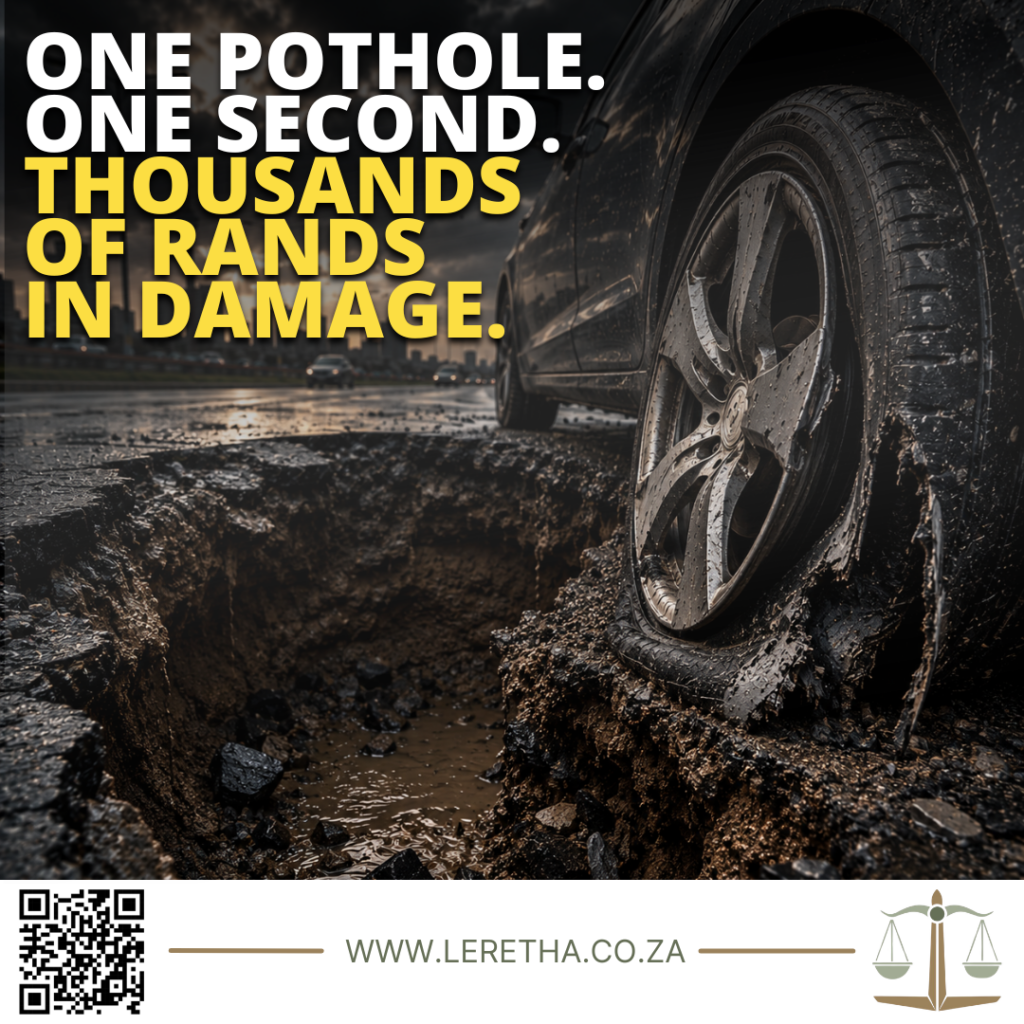
We have all experienced that heart stopping thud. One moment you are navigating the streets of Gauteng and the next, your vehicle is performing a violent interpretation of a trampoline act. In South Africa, dodging potholes has become more than a driving habit. It has become a national survival skill.
But when the “pothole shimmy” fails, who is actually responsible for the bill?
Whether your rim now resembles a taco, you swerved into another vehicle to avoid a crater, or a delivery truck lost cargo after striking a hole at speed, South African delictual law provides a framework for accountability.
Recent Judicial Developments
South African courts have recently tightened the screws on road authorities. What once felt like an impossible fight against municipalities and road agencies is becoming increasingly difficult for authorities to ignore.
The “Digital Notice” Principle (2026)
In Mokoena v City of Johannesburg, the court held that where a pothole has been reported on a public platform such as a municipal app or social media platform like X, and remains unrepaired for an unreasonable period, a municipality’s negligence may be regardedas prima facie established.
In simple terms, once the authority knows about the danger and fails to act, liability becomes far easier to prove.
The “No Excuses” Standard (2025)
In Standard Bank v SANRAL, the Supreme Court of Appeal confirmed that motorists travelling on national roads have a legitimate expectation that the road surface will be reasonably safe.
The court rejected the argument that South African motorists should simply “expect” dangerous road conditions. Authorities cannot hide behind the country’s pothole crisis as a defence for poor maintenance.
The Stewardship Duty (2026)
In Hesse v SANRAL, the court rejected the commonly raised “independent contractor” defence. SANRAL argued that a third party had been appointed to perform road repairs.
The court made it clear that legal responsibility for road safety cannot simply be outsourced. If the road remains dangerous, the authority responsible for that road may still be held liable.
Municipal Liability Confirmed
One of the most significant recent judgments is Botes v Ekurhuleni Metropolitan Municipality [2024] ZAGPJHC 788.
Mr Marius Botes suffered catastrophic injuries after his motorcycle struck a pothole in Kempton Park at night. Following his death, his estate pursued a damages claim against the municipality.
The High Court found that the municipality had a clear legal duty to maintain public roads in a reasonably safe condition. Its failure to repair the pothole amounted to negligence.
Importantly, the court rejected the municipality’s bare denials because it failed to produce meaningful evidence to counter the plaintiff’s case. Photographs, witness evidence, and surrounding circumstances established causation convincingly enough for the court to hold the municipality liable.
The Duty to Warn
In Puseletso v MEC for Police, Roads and Transport (1334/2017) [2025] ZAFSHC 106, the Free State High Court held the MEC fully liable after a vehicle struck a pothole approximately one metre wide on the R34.

The court found negligence because:

  • the department failed to repair known defects;
  • no warning signs were erected; and
  • the road had become extensively hazardous.
This judgment reinforces an important principle: where repairs cannot immediately be carried out, authorities still have a legal duty to warn motorists of known dangers.
Who Is Actually Picking Up the Tab?

Liability depends largely on who controls the road in question:

  1. National Roads (N1, N3 and similar routes)
    Managed by SANRAL
  2. Provincial Roads (R-routes)
    Managed by the relevant Provincial Department of Roads and Transport.
  3. Municipal and Suburban Roads
    Managed by local municipalities or road agencies such as the Johannesburg Roads Agency.
Commercial Losses Are Also Recoverable

The legal consequences do not stop at vehicle damage.

Where a delivery vehicle strikes a pothole and cargo is damaged or destroyed, businesses may potentially claim for pure economic loss. In these matters, telematics, dashcam footage, speed records, and delivery logs can become critical evidence.

Proving that the driver was operating reasonably and within speed limits may significantly strengthen the claim.

The “I Hit a Pothole” Battle Plan
If you suffer damage, frustration alone will not win the case. Evidence will.

Your Essential Checklist

  • Photograph the pothole:
    Include a familiar object for scale.
  • Record a short video:
    Pan from the pothole to nearby landmarks or street signs.
  • Drop a GPS pin immediately:
    Preserve the exact location.
  • Photograph the damage:
    Before the vehicle is moved or repaired.
  • Collect witness details:
    Independent witnesses can become invaluable later.
  • Open a police report within 24 hours:
    Obtain an Accident Report number from SAPS.
Community Action: Reporting Dangerous Roads

If your goal is simply to prevent someone else from suffering the same damage, several reporting mechanisms are available:

  • Pothole Patrol App (Johannesburg):
    A partnership between Discovery, Dialdirect, and the JRA.
  • Vala Zonke App:
    SANRAL’s national road defect reporting platform.
The “Fix It Yourself” Trap

Many frustrated residents consider filling potholes themselves.

Legally, this creates risk.

Road repairs generally require municipal authorisation or a formal wayleave process to ensure repairs comply with engineering and safety standards. An improper repair could expose the person performing it to liability if another accident occurs.
The Six Month Warning
Under the Institution of Legal Proceedings Against Certain Organs of State Act, a claimant generally has only six months from the date of the incident to serve a formal Notice of Intention to Institute Legal Proceedings against the relevant organ of state.
Miss that deadline and the case becomes substantially more difficult and expensive. A condonation application will usually be required, and the court must be convinced that there was good reason for the delay.
Conclusion
Potholes are no longer viewed by courts as unavoidable inconveniences of South African driving. Increasingly, they are being recognised for what they truly are: foreseeable hazards capable of causing serious injury, financial loss, and even death.
The legal position is becoming clearer. Road authorities carry a duty to maintain roads in a reasonably safe condition and, where they fail to do so, they may be held accountable.
But successful claims are rarely built on outrage alone. They are built on evidence, timing, and preparation.
Photographs matter. Reports matter. Witnesses matter. Acting quickly matters.
Whether the damage involves a cracked rim, destroyed suspension, written off cargo, or catastrophic personal injury, the principles remain the same. The challenge is often not whether a claim exists, but whether the evidence is strong enough to enforce it.
At Leretha Legal, we believe accountability does not begin in the courtroom. It begins with understanding your rights, preserving your evidence, and taking action before the damage becomes someone else’s statistic.

Disclaimer: This article is for informational and educational purposes only and does not constitute legal advice. The views expressed are the author’s own and should not be relied upon as a substitute for professional judgment. Practitioners should exercise their own independent judgment and comply with applicable laws, ethical rules, and professional standards when using AI tools in legal practice.